Showing posts with label BLAKE. Show all posts

Friday, April 26, 2013

The Power of the Crowd


My essay is at this link:


It's maybe a little long (sorry!) the end of the semester has that effect on me. But hey, look, a video!

 
                                              (Retrieved from  http://www.youtube.com/watch?v=GCUO3-yq3eg)


Friday, April 12, 2013

Photograph 51

Retrieved from http://en.wikipedia.org/wiki/Photo_51
 
This image played a critical role in fundamentally changing history, in changing the world, by making visible the previously unseen. 
Alone, it appears a mystery, whether boring or beautiful, it is a meaningless abstract of black and white, a Rorschach test with no answers, just something to stare into and wonder. Or at least that is what it was to me, when I first saw it. Its official title is no help, labeled only “Photograph 51,” a title I am sure we would all critique after this class if we saw it alone in a catalog. The story of Photograph 51 is highly contested, however, and has altered over time, and for me that is what is interesting about this image and what it represents. Just seeing it, we might not ever stop to consider it, and it certainly does not grab the heart or your empathy and transport you to a time or place or feeling. It does not look like an image of change, an image reflecting either humanity or the world. But with context, it reveals both of these things, and it is transformed from an abstraction of black and white in an “X” pattern into something much more. With context, its “X” means “helix,” and Photo 51 represents the “eureka” moment in the quest to discover the structure of DNA.
Photo 51 is an x-ray photograph, used in x-ray crystallography to determine the 3-D atomic and molecular structure of a crystal. Developed from 1912-1914, the first atomic-resolution structure to be “solved” was that of table salt, and by 1923 crystallographers were examining organic matter (X-ray crystallography, 2013). For organic matter, crystallographers remove their specimen (a protein, a virus, DNA) from a cell, convert it into crystal form, and shine x-rays into it, as it is backed by a photographic negative. The x-rays are diffracted by the atoms in the crystal, which in effect cast their shadows onto the negatives. These images are then read by trained crystallographers, revealing the 3-D positions and sizes in a molecular structure (Rapoport, 2002, p. 117).
Retrieved from http://www.pbs.org/wgbh/nova/body/DNA-photograph.html

 
Photo 51 was taken of DNA by Rosalind Franklin in May 1952, and was by far the best photograph of its kind, due to Franklin’s skill as a scientist in isolating and creating her DNA samples, and as a photographer in her lab, where she and her assistant had to design their camera and make many of its parts by hand (Gibbons, 2012, p. 65). In terms of her samples, Franklin is credited with distinguishing between a dry A form of DNA, and a wet B form, of which she alone was isolating and imaging at the time. Photograph 51 was the best image taken of the B form, with its clear X revealing a helical structure. In addition, Franklin had correctly interpreted her images to not only report that DNA was helical, but also that it was likely a double helix with anti-parallel strands, had an outside backbone of phosphates, and was within a certain size (Photo 51, 2013).
(An amazing resource for understanding the science of this photograph is NOVA’s interactive “Anatomy of Photo 51” at http://www.pbs.org/wgbh/nova/body/DNA-photograph.html.)
This image was shown to James Watson by Maurice Wilkins, without Franklin’s knowledge or permission, and was critical information in helping Watson and Francis Crick complete their chemical model of DNA. Watson, Crick, and Wilkins would later win the Nobel Prize for this discovery (Franklin had died, and the award is not given posthumously or to groups larger than 3). It is debated, however, if Franklin would have been given the award had she been alive, as especially Watson refused to ever officially acknowledge her role in the discovery or credit her photographs, (his treatment of Franklin in his famous book, The Double Helix, is notoriously misogynistic and harsh,) despite also recognizing that Photo 51 caused his mouth to fall open, his pulse to race, and that it set him and Crick down a new path in their work (Gibbons, 2012, pp. 66-67). Watson and Crick have long been famously associated with this “discovery that was undoubtedly one of the most important scientific achievements of the twentieth century,” but Franklin and her critical photograph are only recently getting a role in that history’s story. 
For me that is part of what makes this image interesting, all of its roles throughout time to different people. To Franklin it was one image in a series of calculated data collection steps, from which she personally preferred to not leap forward into hypothesis. For Watson it was a eureka moment that allowed him to take just such a leap, a playful one while modeling that led to his and Crick’s knowledge being labeled “discovery,” while Franklin’s photo was mere “evidence.” For Wilkins, perhaps it was also only evidence, not proper scientific property of Franklin’s. For some it is a plagiarized image, and for others it is an image of the gender imbalance in the sciences, of power discrepancies that exist still to this day. For science teachers Photo 51 is a story to sell physics (Braun, Tierney, & Schmitzer, 2011) and for creative history teachers it and its story are a rich foundation for lessons in thinking about all of these questions and re-writing (or re-imaging) them into today (Jensen, 2011). Photo 51 has been the subject of a television show, and even titles a recent play about Franklin. 
And, perhaps, this image is beautiful. To many scientists the structure of DNA is considered beautiful, and Franklin’s photographs have been called “among the most beautiful of any substances ever taken” (Elkin, 2003, p. 42). Personally, I do not find Photo 51 beautiful, hypnotic, maybe even eerie, but not beautiful. But does it become beautiful if you have the training to know instantly its hidden messages, to see in its splotches and structure a floating twisting ladder of life? Can an image be beautiful not alone, but because of what its shadows may reveal? 
I obviously do not have the answers to those questions, and something certainly does not have to be beautiful to enact change or be important, but I think contemplating Photo 51’s various meanings and possibilities is an interesting exercise, and one that has been taken on by many. Perhaps that is the true power of photographs of change, that they continue to captivate and tell stories, lending themselves to dialogue and interpretation, holding multiplicity frozen in an image, reflecting back always contested and transforming meanings. As an abstract image Photo 51 belongs to science, along with its unquestionable importance in our knowledge of biology. But it is also clearly much more, layered with such contested human and social contexts, and for me this is why it is current and interesting, and belongs not only in biology textbooks, but in our general cultural visual knowledge bank. 
  -->
REFERENCES:
Braun, G., Tierney, D., & Schmitzer, H. (2011). How Rosalind Franklin Discovered the Helical Structure of DNA: Experiments in Diffraction. Physics Teacher, 49(3), 140-143.
Elkin, L. (2003). Rosalind Franklin and the Double Helix. Physics Today, 56(3), 42.
Gibbons, M. G. (2012). Reassessing Discovery: Rosalind Franklin, Scientific Visualization, and the Structure of DNA. Philosophy Of Science, 79(1), 63-80.
Jensen, M. (2011). What if Rosalind Franklin Were There - Having Fun with Watson & Crick's Famous Picture in a Freshman Genetics Seminar.
Photo 51. (2013). In Wikipedia. Retrieved from http://en.wikipedia.org/wiki/Photo_51
Rapoport, S. (2002). Rosalind Franklin: Unsung Hero of the DNA Revolution. History Teacher, 36(1), 116.
X-ray crystallography. (2013). In Wikipedia. Retrieved from http://en.wikipedia.org/wiki/X-ray_diffraction 

Friday, March 29, 2013

Online Description Assignment

I selected collections presented online at Florida Memory, a website resulting from a grant to digitize select collections from the State Library and Archives of Florida. Their mission is to “provide online access to archival resources housed in the State Library and Archives that illustrate significant moments  in the state’s history, offer educational resources… and make available collections for research” (Florida Memory, n.d.). Their photographic collection is a searchable image database of over 176,000 photographs. I would imagine their users are quite diverse, including government agencies, researchers, teachers, students, and casual browsers, but all would be most likely interested in FL history and culture.
Screen captures are sometimes hard to see on the blog, so I decided to just provide the links for the items I  analyzed.
For collection level and item level description I focused on the Robert E. Fisher Collection. This collection description is informative and contains a lot of the types of information and content covered in our readings and in class, but it is not without faults and inconsistencies.
Two problems are, unfortunately, the major access points of the title and creator name. In their list of collections, and on the collection page itself, the collection is referred to as the “Robert E. Fisher Collection,” however, under “Title” in the finding aid it is the “Robert Fisher Photographic Collection, 1941-1961.” Fisher is referred to with and without his middle initial inconsistently in this collection level finding aid and in the item level records. I personally think the title with dates and naming it a “photographic” collection is preferable due to its specificity, but either way a consistent naming standard is necessary here. Writing about this collection, or citing an image, is frustrating if you do not know what to call it or how to correctly refer to the photographer.
An additional vocabulary problem at the collection level is the photographs themselves. The one sentence summary/abstract of the collection at the beginning of the page is a great idea, but if I was opening up this aid and read only the first title and that line, I would not know this was a collection of photographs, as it refers only to “images.” The abstract should refer to them as photographs, although it is unclear if they are prints or negatives since each is mentioned in the description below. My guess is that the actual physical collection of 3000 images are photographic negatives, but that the 1200 images online are positive prints (what kind of prints and how, who knows?), but this is only my interpretation and these details about the photographs, including any information on their processes, should be explicit in the collection description.
Besides these faults, the collection description does provide excellent detail in a concise format. The amount of text is easy to read on screen, and extent, date, and geographic location information is provided along with a large number of subject terms for search and access. Given the ability to search the collection by keyword or subject, these terms are useful access points. A brief historical note on Fisher is also helpful, reinforcing the fact that he was a commercial photographer specializing in aerial photography.
This link is the records for the photographs if you select “view all” from the collection level description. Two things about these records were immediately confusing and frustrating to me as a user. First, the dates are awful, to put it plainly. I know from the collection description that this collection covers 1941-1961, so if a specific date is unknown then that range should at least be entered. The date as only “19-- “ is pretty lazy I think, and should be unacceptable. I also found the “collection” confusing, as these are listed as being in the Florida Photograph Collection, but also the Robert E. Fisher Collection. From my search I know I am in the REF Collection, any searching or sorting I do from this page in the website is in that collection. It is not helpful to list the larger overarching photographic collection of Florida Memory by name here, and I am not sure why it is present.
In terms of item titles, the first three images alone demonstrate that the photographs either have author-supplied titles or that the archive did not use a standard for titles (as the third is missing location information) and I hope it is the former. However, the titles here, while not consistent, are fairly simple and descriptive, and do represent what one would expect to find in their visual counterparts. This is helped by the presence of the image thumbnails, which is a good feature for users, and it is nice that selecting a title brings you to its more detailed record.
I looked at the item record for the photograph “Moped-Jacksonville, Florida.”  I have already discussed the problems with the dates and inconsistent creator name. In contrast with the collection description, the physical descriptions in the item records are all consistent, naming the records “photonegatives,” listing them as black and white, and giving their size. However, in looking at this image online, it is a positive image, and so it is unclear to me what “photonegative” means in this context. Is it describing the physical item (that is my guess) and not the online positive surrogate? This should be explained here or in the collection description. The term “photonegative” is also not from any of the controlled vocabularies we discussed in class, so it is unclear why this local and imprecise term was selected. The “series title” is also confusing, listing the whole collection and also the specific box, folder, and envelope of this item. While it is nice to link back to the collection description, and helpful for context to see where this photograph is located in terms of its physical organization within that collection, I think the term “series title” itself is unnecessary here, especially as there are not actually multiple series within this collection. More appropriate terminology might be “Collection” for the general information, and “Specific location within collection”.
The access terms in these records are excellent and detailed however, as they were at the collection level. Both subject and geographic terms are listed, and from what I can tell they are using the Library of Congress vocabularies for these. In some records the subject and geographic terms do tend to overlap, but I think this extra information is better than too little, especially as there is a subject search and someone might use a geographic term in that and want results.
The REF Collection does not have any albums, so I wanted to see if I could find any in the Florida Memory site. The do have several, mostly in “The General Collection,” their main photographic collection documenting a comprehensive visual history of FL from mid-1800 to the present. One album documented belonged to Harry Holmes, who moved to FL in 1952.
Above is a link to an item level record for a photograph from this album. The record is not clear that it is from an album, actually, but I assume it is as it is contains the same general note about the rescued Holmes album as a number of other records. This record has some similar problems noted earlier (dates, physical description (what is a “photoprint”?)) and some of the same strengths (informative title and subject headings). However, in terms of analyzing this as an album, this description is not adequate. A general note discusses “the album,” but is this photograph a part of it, and if it is, where in the album does it belong? More frustrating, is that there is no easy way to see all of the images from this album in context. You can collect them if you search for the general note about the Holmes family and see what records it is in, but this is clunky and showing the album as a full document, providing context to these images should be a priority for these records.
REFRENCE:
Florida Memory. (n.d.) About Florida Memory. Retrieved from http://www.floridamemory.com/about/

Wednesday, February 27, 2013

Midterm: Stereoscopic Photography


From the Greek “stereo” (“solid”) and opsis (“power of sight”) stereopsis is perceiving depth, relief, or three-dimensions (stereopsis, n., 2012). This ability is most commonly due to binocular vision, where the spacing of two eyes creates separate images of a scene from slightly different angles, which are then combined into one vision with three-dimensional quality in the brain.

The application of three-dimensional vision to two-dimensional images, by using a viewing implement, or a stereoscope, was first described by English physicist Charles Wheatstone in 1838. He created his stereoscope with prisms and mirrors, and it was originally used for viewing drawings.
Wheatstone stereoscope. Retrieved from http://en.wikipedia.org/wiki/Stereoscope

Scottish physicist David Brewster improved the stereoscope in 1849, inventing the “refracting” or “Lenticular” stereoscope, which was reduced in size and used lenses instead of mirrors. He also invented the double camera for taking stereoscopic views, which were afterwards mostly produced with such double-lensed cameras.

These photographs were produced as stereographs, with two images side by side. Stereographs are a photographic format, not process, and were produced using multiple technical processes over time, including the daguerreotype, ambrotype, wet plate glass positive, mounted salted paper print, albumen prints, and gelatin print processes (Ritzenthaler & Vogt-O’Connor, 2006, p. 41). The majority of stereographs, also called stereo views, were mounted on cards.
Folson, A. H. (c.1850-1929). Trinity Church, Boston. Retrieved from http://www.flickr.com/photos/boston_public_library/2351548106/in/set-72157604192771132
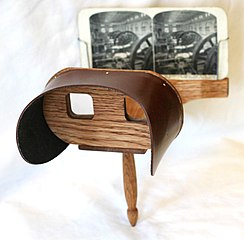
 Daguerreotype stereographs were first publically exhibited in 1851 at the London International Exhibition, and were received enthusiastically by Queen Victoria and others (history of photography, 2013). Their popularity grew even more with the simple hand-held version of the stereoscope developed by Oliver Wendell Holmes in 1861. Holmes’ invention, which was easy to manufacture, combined with his excited promotion of stereoscopes and stereographs in The Atlantic, helped to boost the already popular form in the United States.
http://upload.wikimedia.org/wikipedia/commons/thumb/f/f6/Holmes_stereoscope.jpg/244px-Holmes_stereoscope.jpg
Holmes stereoscope. Retrieved from http://en.wikipedia.org/wiki/Stereoscope
Stereographs were extremely popular from 1850 through the 1920s and 1930s  (the rise of newsreels), and during this period millions of stereographs were produced. Photographers were sent out to photograph the world, and manufacturing the views was a big business. One of the first firms to produce stereographs was that of the Langenheim brothers, and later the leading publishers were Underwood & Underwood and the Keystone Company. Views could be bought individually, or more often, in large topical groups.

Stereoscopes became a popular instrument for home entertainment and education (much like radio, and then TV) and had an important impact on public knowledge and taste. Holmes was correct in his statement regarding the stereograph that, “Men will hunt all curious, beautiful, grand objects,” as the market for stereographs was expansive, and diverse (1859). Images captured local history, grand landscapes, foreign scenes, important people, architecture, war, disasters, and later on, staged scenes of humor and the home. Curiosity about the world was a huge force in stereographic popularity, and travel images as souvenirs, and of places one might never see, were very popular. 
Norman Rockwell painting of a boy viewing Egypt through his stereoscope. Retrieved from http://en.wikipedia.org/wiki/File:Rockwellboywithstereoscope.png
The expansion of the business of stereographs and their broad popularity not only impacted those directly involved, but also had an indirect impact on other branches of photography and visual theory at the time. Holmes not only wrote of the curious and beautiful objects available in stereographs, but also noted that “form is [now] cheap and transportable” (1859). Whether intentional or not, this idea was felt by those who saw in the stereograph (especially by the end of the century when stereographic photography had become quite uniform,) the cheapening of photography into popular commercialism. While these images would inform the conventions of publicity and advertisement photography in the future, they also pushed some photographers into “High Art” in response to “stereoscopic trash” (Jeffrey, 1981, p. 38).

Despite these other opinions, and the branching out of new forms in reaction to stereographs, it should be clear that stereographs hold great importance for cultural heritage institutions who might seek to collect, preserve, and offer access to these images. The broad use of stereographs in everyday residential life during these decades, along with the diversity of tastes and communities served by different stereograph subjects, has a strong impact on their usefulness for researchers in a number of fields. Their cultural currency is obvious in terms of looking at mass media, middleclass households, education, and the images themselves are rich in visual and contextual information, covering topographic views, local history, events, industries and trade, costume, urban and country life, humor, and portraits. They are also important for researching the history of photography itself, having been produced by multiple processes (stereoscopic photography, 2013). Preservation of stereographs is accordingly diverse, depending on the process by which they were made.

Stereographs and stereoscopes form an early node in the history and technology of three-dimensional viewing. Anyone who played with a slide-viewer growing up, crossed their eyes at a "Magic Eye, or enjoyed 3D at the movies has taken part in this history.

References

history of photography. (2013). In Encyclopædia Britannica. Retrieved from   http://www.britannica.com/EBchecked/topic/457919/photography

Holmes, O. W. (1859, June). The stereoscope and the stereograph. The Atlantic, 6. Retrieved from http://www.theatlantic.com/magazine/archive/1859/06/the-stereoscope-            and-the-stereograph/303361/

Jeffrey, I. (1981). Photography: A concise history. New York: Oxford University Press.

Ritzenthaler, M. L. & Vogt-O’Connor, D. (2006). Photographs: Archival care and management. Chicago: Society of American Archivists.  


Stereoscopic photography. (2013). The New York Public Library. Retrieved from http://stereo.nypl.org/about/stereoscopy

Wheatstone, C. (1838). Contributions to the physiology of vision: Part the first. On some remarkable, and hitherto unobserved, phenomena of binocular vision. Philosophical Transactions, 128, 371-394. Retrieved from http://www.stereoscopy.com/library/wheatstone-paper1838.html

Additional Resources

The Getty Museum has produced a nice simulation of stereo viewing.


The Center for Civil War Photography, 3-D Anaglyph Photography Exhibit:
http://www.civilwarphotography.org/3-d-anaglyph-photographs-exhibit 

Collection Records


1) http://webapp1.dlib.indiana.edu/cushman/overview/collOverview.jsp
Charles W. Cushman Photograph Collection: Collection Description
This description is too long for a screenshot, but I think this is a good example of a collection level description. Given the four series it is not too long, it covers the dates and extent of the materials, and genre and form. It also covers provenance, processing, original storage, preservation and new storage. Given all of the text, however the lack of detail regarding subjects, names, and themes was surprising. The link to the B&W photographs takes you to a page that offers just these types of things, so maybe they just figured people would explore the links.
Some more detail could be added to the collection description without adding too much length, with a good impact on description and the number of search terms for discovery and access. They have already decided to have a description that is long, they might as well include some of these details.
Chicago Historical Society Research Center: State Street autumn festival photograph collection [graphic]
This is a very different type of description from the one for Cushman, being in a catalog with many other collections and not at its own website/portal. But I also think this is a good example of a collection description. The title is detailed, it gives the dates, extent, form, controlled subjects (thematic and geographic), and the summary describes the event with details and also names the notable scenes for aid in discovery. I think a researcher would be able to see this description and generally know if this small collection was appealing or not.