For those who may have been interested, here is the link to the "inside the clan" photographer I was talking about.
Christoper Capozziello Photographer
I urge you to explore his other works. Especially the video about his twin brother.
Thanks for a great semester!
Sarah
Showing posts with label SARAH W. Show all posts
Showing posts with label SARAH W. Show all posts
Saturday, April 27, 2013

Friday, April 26, 2013
In an Instant
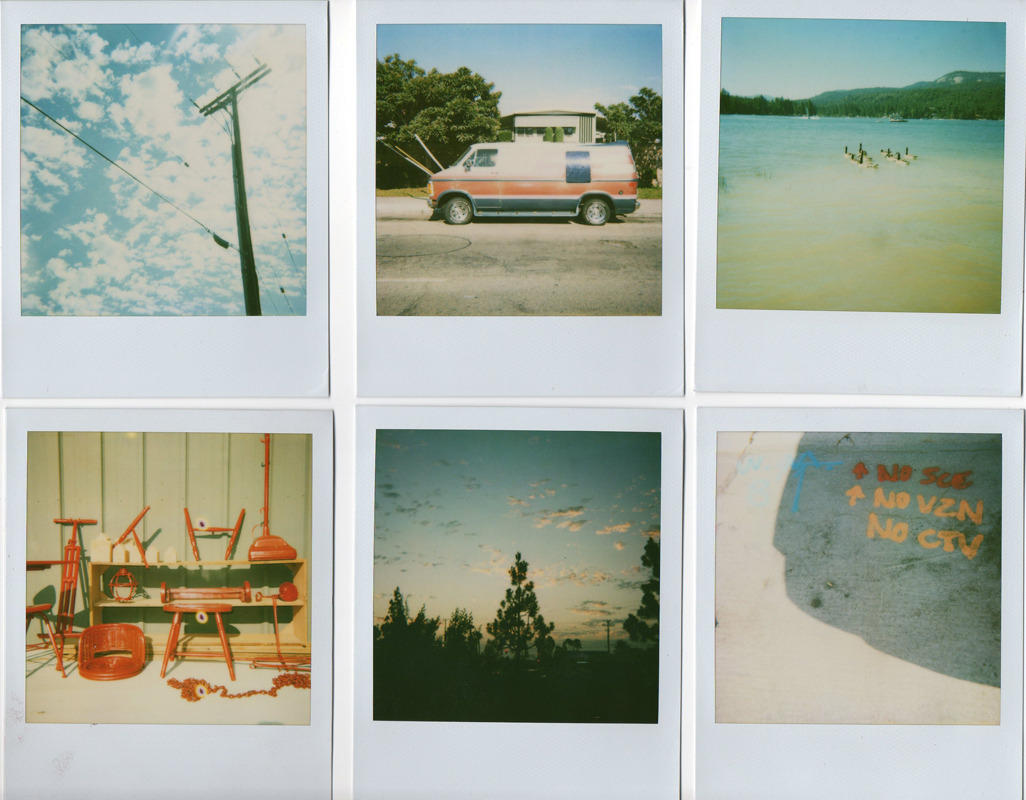
When I was twelve, I received one of the
greatest gifts of my life, a Polaroid camera and a pack of 600 film. In an instant, I was hooked. I photographed all of the important elements
of my twelve-year-old world: my house, my mom, my pets, my bedroom, and my
friends. I would save up my babysitting
earnings to spend on more and more film.
I had a 35mm camera, but it just wasn’t the same. There was something magical about my
Polaroid, something hard to explain, but I felt it when the camera made it’s
unique sound and my photo was released.
Play for that awesome sound!
Polaroid camera
“I think the new camera can have an impact on the way people live. I hope it can become a natural part of people. It can make a person pause in his rush through life. It will help him to focus himself on some aspect of life, and in the process, enrich his life at that moment. This happens as you focus through the view finder. It’s not merely the camera you are focusing; you are focusing yourself. That’s an integration of your personality, right that second. Then when you touch the button, what’s inside you comes out. It’s the most basic form of creativity. Part of you is now permanent.” Land, Time Magazine 1972
Land’s greatest achievement was the SX-70 and remains unmatched even by today’s most sophisticated digital camera. The SX-70 made it possible for anyone to aim their camera, focus, press the shutter button, and instantly place a physical print in their hand. This is quite a remarkable thing.

SX-70, moominsean.blogspot.com
I'm not twelve anymore, but I still get the same feeling when I use a Polaroid camera. It's instant, exciting, and magical. No digital camera can give you a one-of-a-kind, direct positive image in the palm of your hand. That's truly special.
Play for that awesome sound!
Polaroid camera

I knew that my Polaroid was special, completely unaware of
its history or it’s extraordinary inventor.
Polaroid instant cameras entered the consumer market in 1948. They captivated amateur and avid
photographers alike, with the amazing ability to produce instant pictures in 60
seconds or less. This incredible achievement was the pioneering invention of Edwin
H. Land (May 7, 1909 – March
1, 1991). Born in Bridgeport, CT, Land was a scientist and inventor who
dropped out of Harvard after his freshman year. He co-founded Polaroid in 1937,
with the vision that the instant camera would become a key element in people’s
daily lives; just like the telephone and the television.
 |
| Edwin Land showing off his inventions |
“I think the new camera can have an impact on the way people live. I hope it can become a natural part of people. It can make a person pause in his rush through life. It will help him to focus himself on some aspect of life, and in the process, enrich his life at that moment. This happens as you focus through the view finder. It’s not merely the camera you are focusing; you are focusing yourself. That’s an integration of your personality, right that second. Then when you touch the button, what’s inside you comes out. It’s the most basic form of creativity. Part of you is now permanent.” Land, Time Magazine 1972
How does it work?
Original
process:
A
negative material was exposed inside the camera, and then pulled out while
being squeezed against a chemical layer and a positive material. After 60 seconds
or less the layers could be separated
and the negative discarded.
Current
Polacolor process:
Inside
the camera, light makes a series of latent images on dye layers of the film. When
the picture is auto-ejected from the camera, a processing chemical activates
the image in the dye layers. After a few
minutes, the final form of the print is revealed and protected by a hard
plastic film.
Land’s greatest achievement was the SX-70 and remains unmatched even by today’s most sophisticated digital camera. The SX-70 made it possible for anyone to aim their camera, focus, press the shutter button, and instantly place a physical print in their hand. This is quite a remarkable thing.
SX-70, moominsean.blogspot.com
The SX-70 was a
single-lens reflex (SLR) model, which simply means, what you saw in the
viewfinder was what you got. It was the true realization of Land’s dream of
creating, “absolute one-step photography.”
The fall and rise of Polaroid
Despite
Land’s great achievements and the appeal of instant photography, Land would be
asked to step down and Polaroid would fall out of favor with consumers.
Polaroid
filed for Chapter 11 in 2001, was bought by the Petters Group in 2003, went
bankrupt again and was sold again in 2008.
Polaroid had stopped manufacturing instant cameras in 2007 and finally
announced it would cease production of its instant film in 2008. Thankfully,
for people like me who have a nostalgia for instant photography, there is the
Impossible Project.
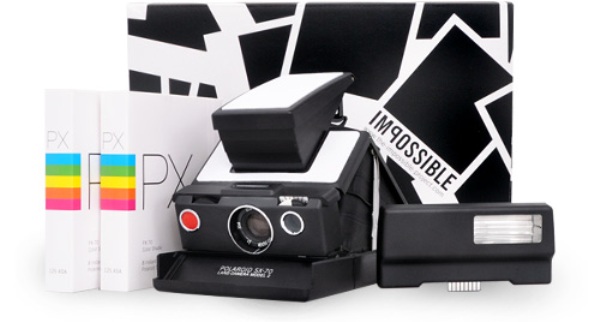 |
| Impossible Project Products |
“Polaroid’s end of production didn’t mark
the end of interest in Polaroid photography. Actually, it helped jump-start its
rebirth. What had been an unwanted commodity suddenly looked like a precious
resource.” http://technologizer.com/2011/06/08/polaroid/
Excerpt from website: “In October 2008 The Impossible Project saved the
last Polaroid production plant for integral instant film in Enschede (NL) and
started to invent and produce totally new instant film materials for
traditional Polaroid cameras. In 2010 Impossible saved analog instant
photography from extinction by releasing various, brand new and unique instant
films.
Therewith Impossible prevents more than 300,000,000
perfectly
functioning Polaroid cameras from becoming obsolete, changes the world of
photography and keeps variety, tangibility and analogue creativity and
possibilities alive.”
For more information:
Polaroid official website
List
of Cameras:
Timeline
of Polaroid’s history.
Edwin Land
The Impossible Project
Insisting on the Impossible, Edwin H. Land biography
Polaroid’s SX-70, the Greatest Gadget of All time, Is 41
Polaroid’s SX-70:
The Art and Science of the Nearly Impossible
MUST WATCH THIS VIDEO!
Caring for your photographs
BONANOS,
CHRISTOPHER. 2012. "It's Polaroid's World - We Just Live in It." Wall Street Journal - Eastern Edition,
November 10. C3.
"Edwin Herbert Land." 2013. Columbia
Electronic Encyclopedia, 6Th Edition 1.
Sunday, April 14, 2013
Triangle Shirt Waist Company Fire
 |
| http://digitaljournalist.org/issue0309/lm24.html |
Photographs alone have the power to evoke emotion, but when they are used to help illustrate a tragic news story, they have the power to inspire change. Without photographs we can only imagine what something looked like and often we are only capable of using images from our own memory banks to help make sense of something we’ve read. This is why photojournalism is such an important part of the American story, because with photographs, the story becomes that much more real. With photographs, the public doesn’t need to rely on the pictures in their mind. They are given first hand accounts into what really happened and that triggers an emotion. For some, that emotion is anger, fear, or grief. It is undeniably human and has lead to movements that have changed the human experience for Americans. For American laborers this meant the promise of safe and fair working conditions.
 |
| Ladders and hoses were not adequate to subdue the fire. http://bit.ly/ZjHKBR |
On Saturday afternoon, March 25, 1911 a fire broke out on one of the top floors of the Asch Building, where the Triangle Shirt Waist Company workers were finishing up a days work. In less than 20 minutes, 146 of the 500 young immigrant workers lost their lives. They were trapped. In an effort to prevent workers from stealing material, managers would lock the doors. Those who survived the fire testified that the exit door was locked. The fire escape did not lead everyone to safety and broke under extreme weight of people trying to escape. Many went to the windows and waited for firemen to rescue them. The ladders and water could not reach them, so they decided to jump instead of burning alive. The Triangle Shirt Waist Fire is known as one of the worst workplace disasters since the Industrial revolution.
 |
| Next of kin attempt to identify victims of the Triangle Shirtwaist Company fire, New York City, 1911; © Bettmann/Corbis |
 |
| Makeshift morgue for families to identify their loved ones. http://bit.ly/ZjJ2Nr |
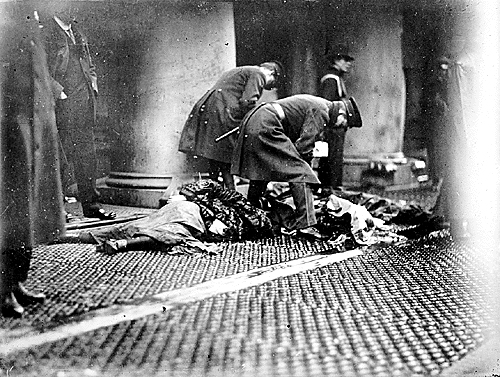 |
| Police officers arranging bodies of workers who leapt to their death. http://bit.ly/ZjIsiz
The Triangle Shirt Waist Company was a sweatshop owned by Max Blanck and Isaac Harris. These two entrepreneurs subcontracted hiring managers who had the authority to control wages and hours any way they saw fit. Since they were given a percentage of profits, it was in their best interest to overwork and underpay their vulnerable immigrant work force. Although Triangle was a non-union shop, some workers were members of the International Ladies’ Garment Workers Union. Concerned for the health and safety of desperate immigrants, the ILGWU fought hard to organize women working in the clothing trade to achieve better working conditions and improved legislation. Before 1911 many of workers in the garment district of Manhattan were unorganized. After the Triangle fire tragedy movements toward collective bargaining and unionization grew stronger.

Young garment workers organizing for fair and safe working conditions. http://www.time.com/time/photogallery/0,29307,2061268_2258989,00.html
Photographs of the horrific tragedy helped strengthen the organized labor movement by making the public more acutely aware of exactly what happened. Without these photographs, the horrible visual aspect of the story could not have been told. The New Yorkers living and working in the area where the tragedy occurred unfortunately had a first hand account of that terrible afternoon. The rest of the newspaper reading world could experience a similar shock through the graphic pictures reproduced en-mass via the printed news.
Post fire, the people of NYC were grief stricken by this needless tragedy. People demanded justice and called for the owners to be put on trial. The Joint Relief Committee and the American Red Cross helped the survivors get the care they needed. Blanck and Harris were indicted on April 11th for manslaughter in the second degree under section 80 of the Labor Code, which mandated doors be unlocked during working hours. They were acquitted on December 27th only 23 days after the trial began. The jury was not convinced that the owners knew the doors were locked. Grieving families, as well as the public, did not feel justice was served. 23 individual civil suits were filed. Blanck and Harris ended up paying each family $75. The Triangle Shirt Waist Company closed in 1918. The owners never acknowledged any wrong doing and described their factory as a model of clean and sanitary conditions.

(Laborers couldn't even stop long enough to have this photo of the factory floor taken. Notice the floor manager on the right looking at the camera.
http://bit.ly/17Afxdy)
I think we must thank the photojournalists and the newspapers for illustrating this tragic news story with documentary photographs. By appealing to the broken hearts, shock, and anger of the American people, they helped strengthen the movement to protect workers from exploitation.

Clip from unknown newspaper article. http://bit.ly/ZrcrC7
|
Friday, March 29, 2013
Oklahoma History Center
Oklahoma History Center, Photo Archives
I had high hopes for what the Oklahoma History Center had to
offer in terms of a digital photograph collection. I was immediately drawn in by the compelling
image on the research center home page.

From the start the page looked very professional and was pleasing to the eye . There was a fair amount of white space, a good color palette, content was well organized, and I was confident that navigation and usability would be top notch. That being said, what was most important to me were the catalog records for the photographs, so I clicked the Search Catalog button, excited to see what I would find. This took me to the Oklahoma Historical Society portal with a selection of four catalogs to search. I clicked on "Archives Catalog."

This took me to the main search window which looked similar to a library OPAC. Th confidence that I had when I started at the OHC homepage began waining. I was already on a third page and the appearance of the pages seemed different every time. What started as the Oklahoma History Center changed to the Oklahoma Historical Society, color schemes changed, and although there was an attempt at branding this too fell short because the society's logo went from color to white. At this point I was convinced that the collection was going to be disappointing. So, I decided to perform a search on “children,” one of my personal interests and the subject of some of my favorite photographs.

I was pleasantly surprised at the search results and excited to see some glass plates! A cursory glance revealed a fairly sizable and interesting collection of what appeared to be local donations and publicity documentation. My confidence was restored!

A less cursory examination quelled my excitement. Aside from having a skillfully digitized, interesting and accessible collection of photographs, the catalog
records are abysmal. It’s difficult to
decide where to begin discussing what is lacking in the catalog records, so I
will continue to recreate a search and attempt to describe how the catalog
records fall short as I go along.
Notice the first line on each record. The results reveal a ranking order and
display that ranking order as a textual part of the record. Unfortunately, there is no indication as to
how the results are ranked and there is no option for changing the type of
rank. For example, I’m not given the option
to “rank” or sort by date or format. The number at the beginning of the title is the accession number and the only reason I know this is because I read the pdf from the home page that explained how to successfully search and navigate through the online catalog. Following the accession number is a title. The same title seems to appear for all of the photographs in this collection. I was particularly interested in the image
that was ranked 2 and had hoped to learn more about it after clicking directly on
it.

Unfortunately, this only reveals the image without any metadata. So, I returned to the search results to see if there was another way of finding more information about the image through the object record. I clicked on, “See more about GLASS PLATE,” hoping this would reveal more metadata that would describe the item more thoroughly.

This resulted in a description of the Oklahoma Historical Society’s policies on rights and reproduction and which collection and box the photograph is physically stored in, but little information about the photograph itself. I’m also not sure what “Box. 1 Box 1.” means. Is this a box with no folders or a glitch with the software used to catalog the collection? Does the lack of metadata mean that no information came with the donation of the collection or did the cataloger not see fit to include it in the object record? Interestingly, this is also what appears when I clicked on “Display Finding Aid.” Where is the description about what a glass plate is? There are no listed subjects or tags. The image is beautiful, but what are we looking at. If the Oklahoma Historical Society doesn't know, perhaps they should consider mentioning that they have no "bibliographic" information about the Ward Brothers Collection. If OHS doesn't have any information, it begs the question as to whether or not it makes sense to make the images accessible. Are users of the site actually taking away any useful knowledge about the photographs? Or is this an opportunity to just look at pretty pictures?
At this point, I was curious if there was at least a descriptive summary about the Ward Brothers Collection that would reveal more information about the photographs included. I started by clicking on “Show Hierarchy.”

A new window popped up with the title of the collection and the name of its only series, “Format 1. Photographs.” I was hoping it would lead to a summary about the collection. It did not.
I decided to take a look at an example from the Ray Jacoby Collection. Perhaps something more contemporary would lead to more information?


First, why are so many ranked 19? Very curious. Again, instead of having a well organized and delineated selection of metadata, we have a long title that begins with the accession number and is followed by as much information about the photograph that can possibly fit. I clicked below one of the photos to "See more about PHOTOGRAPH (BLACK AND WHITE)," hoping to find out more. This simply led to more confusion.

Suddenly, what was once described as a black and white photograph has become a negative and all of the metadata is in the title. Clearly, OHS is not employing any recognizable metadata standard or schema. Displaying the Finding Aid also lead to an explanation of restrictions of access and use and preferred citation. I debate the need for this, since I don't think anyone will learn enough from the records to find them useful for their publications. What to try next? I decided to go back to the search page and access one of OHS's core collections to see if more attention was given to those records.


I chose their Indian Archives because this is another personal interest of mine, being Native American myself. This immediately opened up to an extensive Finding Aid. Optimism restored!


Obviously, this is a part of OHS's collection that has high research value in the community and certainly received attention from the archivist. I would be interested in finding out whether the information came with the collection or whether the archivist performed the research necessary for this level of information-rich record.

Series are listed on the left hand side and at the bottom of the Finding Aid. Access to the individual series is done through the links on the left. My hope was that this would lead me to some photographs with rich metadata content. I chose the Chilocco Indian School Records to see if I could find some photographs of Indian children. This series alone contained 224 boxes! Great, so are there any photographs? I was unable to find any through the Finding Aid, so I decided to go back to the search menu and search on Chilocco children. There was one photograph.

The metadata is in the title, but lacks the date, which is given in the title on the search results page.
So far, what I've discovered is that photographs are removed from their original collections and placed in a sub series of Photographs, which is why I didn't see it in the Chilocco Finding Aid. This is assuming that the photograph came with that collection originally.

Okay, one last try. I decided to do a search on "fashion," a research interest of mine. Topped ranked items were from Aunt Bettie's Album Collection.

This is what I was able to find out from clicking on the image and on "See more about PHOTOGRAPH (BLACK AND WHITE).


This revealed that at some point, the archivist was thinking about Subjects and Creators and using them as cataloging tools. Something I didn't see in other examples. So it's possible, just not used consistently. I like that they have a metadata field for Media, but what about format. Clearly, we have a CDV or a Cabinet Card. It would be nice to see this information somewhere in the record.
As stated in the beginning of this blog entry, I entered the Oklahoma History Center's online portal with high hopes. My first impression was that I would be impressed with what they had to offer both in terms of it's visual presence and its content. As you may have been able to tell, I was disappointed. The OHC's page was full of great information, but the OHS's photographic records were missing a fair amount of information. I support access and I really enjoy the visual experience of photographs in a digital archive environment. I do however expect, that if a collection is going to take the time to digitize and upload to the internet, then they should also take the time to give the public as much information as they possible can. Even if that information is "Creator: Unknown," or anything that reveals an attempt was made.
example of the useful information on OHC's site.
Subscribe to:
Posts (Atom)